What to Look for in a F2P Retention Engine
What it really means to use a CRM purpose-built for free-to-play

Finding a retention platform that meets the needs of your mobile games can be a challenging task. As a retention manager, you might sit through multiple demos before deciding on a CRM that looks powerful, flexible, and proven in other industries.
The real problems show up later.
Development timelines drag on, campaigns feel harder to ship, and rewards become a negotiation instead of a lever. Retention teams start realizing they’re missing capabilities they never knew to look for.
This is the quiet cost of using tools that were not built for how F2P games actually work.
Free-to-play operates on daily engagement
Unlike e-commerce, which is looking to close sales, F2P value comes from players returning again and again.
Most CRMs were built for low frequency interactions, long consideration cycles, and conversion events like purchases or page views.
Games are different.
Players log in multiple times a day. Churn happens fast. Rewards are part of the core experience. Messaging isn’t a reminder to keep browsing. It’s an opportunity to play.
When your CRM isn’t optimized for retaining your core players, teams end up working around the tool instead of with it. Suddenly, the tool becomes a blocker to your strategy.
What free-to-play teams actually need
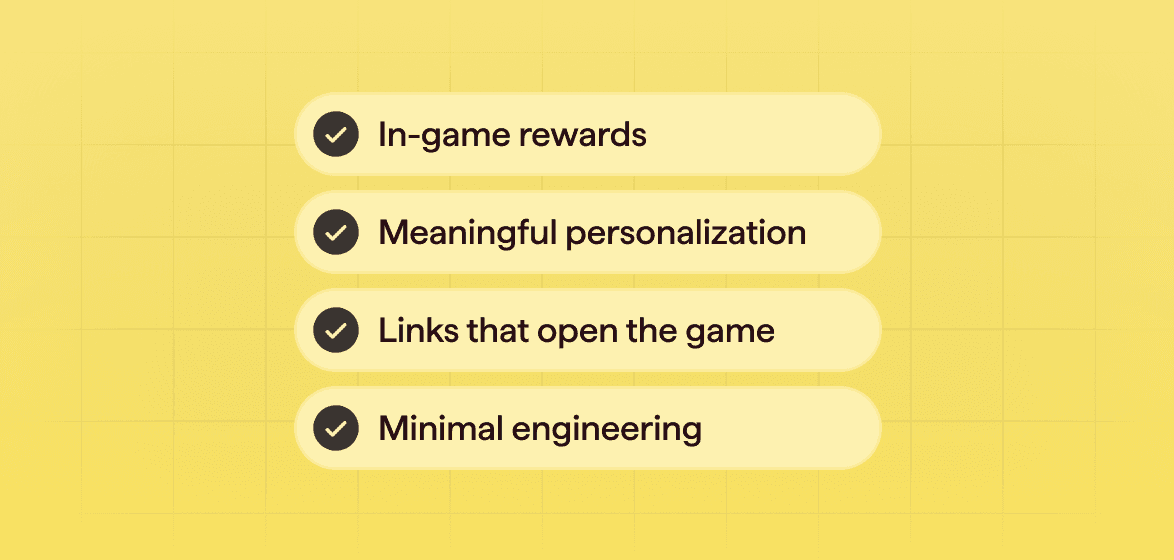
Rewards as a core offering, not an afterthought
Any free-to-play game worth their weight in digital coins knows that in-game rewards aren’t just a nice feature, they’re a key part of the game. In fact, we’ve seen F2P studios use rewards to increase their CTR by 50-100%. Rewards are how you reactivate lapsed players, reinforce habits, and make messages feel worth opening.
When in-game rewards are too difficult to attach to a push or email, teams either underuse them or spend months building custom systems. The outcome is slower iteration and fewer meaningful touchpoints.
A retention engine designed for games will make rewards part of the message itself. Players return with value in hand, and teams can test what actually drives engagement.
Personalization based on real player behavior
Most CRMs offer personalization, but it is usually built around browsing or purchase behavior.
Games need to react to sessions played, levels completed, spend patterns, and time away. These signals tell you who is engaged, who is at risk, and what kind of incentive will move them.
When personalization reflects how players actually play, messages feel relevant instead of noisy. The result is higher response rates and more consistent daily active users.
Links that reliably open the game
Broken links quietly kill otherwise strong campaigns.
If a push or social post takes a player to a login screen, fails to open the app, or doesn't give the player the promised reward, the moment is lost. In a high-velocity environment like F2P, those moments matter.
Reliable deep links that directly open the game remove friction and increase the chance to turn intent into a session.
Minimal engineering needed
Every week an engineer spends maintaining a CRM integration is a week not spent improving the game.
Legacy platforms require months of setup and ongoing custom work to support rewards, deep links, or real-time triggers. This slows down marketing and increases the risk of churn.
A CRM with game-ready tools reduces this burden. Faster setup means teams can launch, test, and iterate without pulling engineering into every campaign.
Retention marketing shifts when these requirements are met
When a team uses a retention engine purpose-built for F2P games, they send more relevant messages with fewer headaches. Rewards are calibrated instead of blunt. Campaigns launch in minutes instead of days—and improve over time.
Most importantly, players are met with timely value that keeps them playing more. This is what treating every player like a VIP actually looks like in the free-to-play world.
Teak was built around these realities from the start
Since 2012, we’ve focused exclusively on F2P games. Rewarded messaging, game-specific personalization, reliable links, and fast setup are not add-ons, they are foundational.
F2P studios use Teak to launch frequent, reward-driven campaigns that feel native to the game and easy to manage.
So if you’re currently evaluating retention tools, the most important question to ask is this:
Does the platform understand exactly how your game keeps players coming back?
Ours does.
Book a demo to learn how.